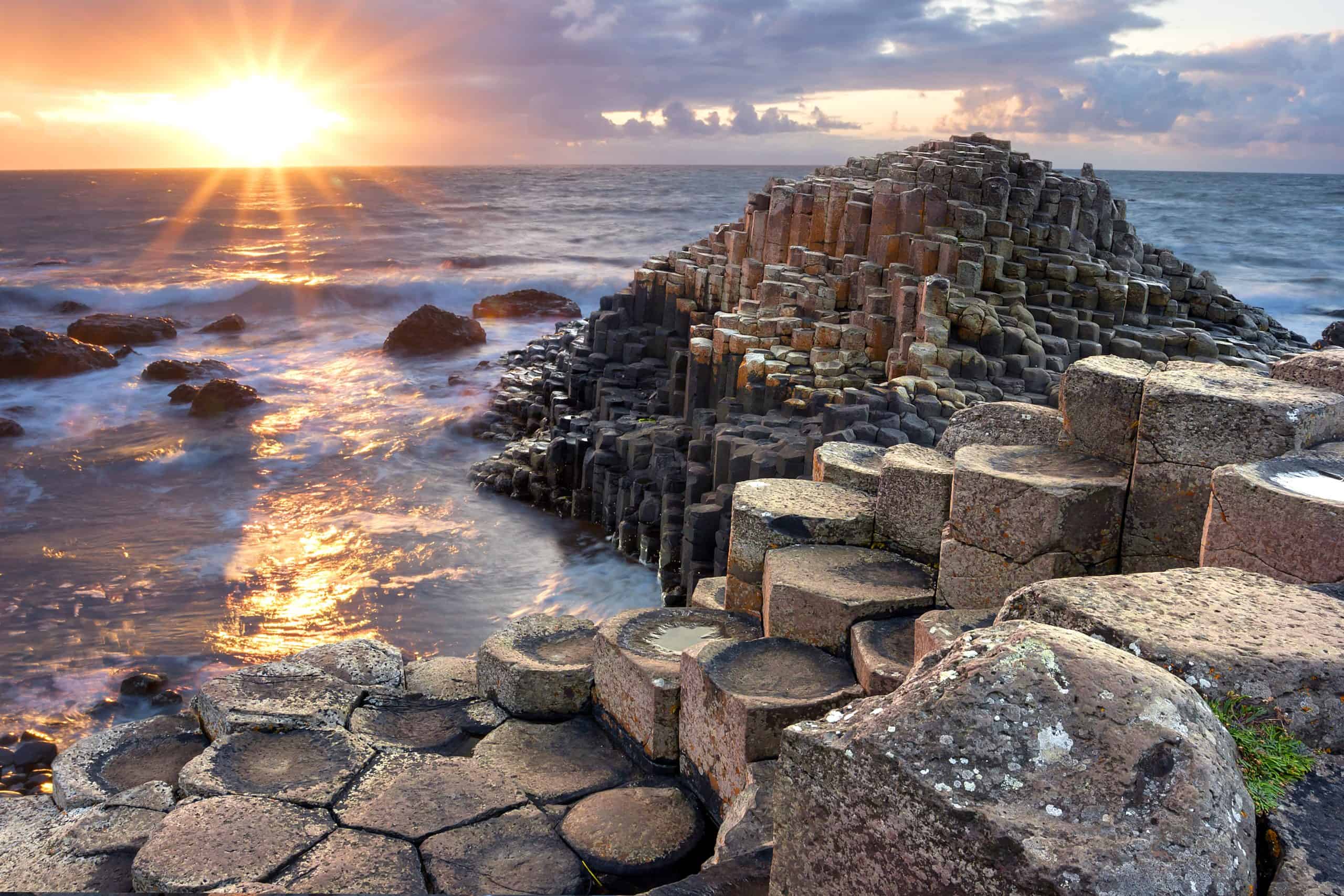
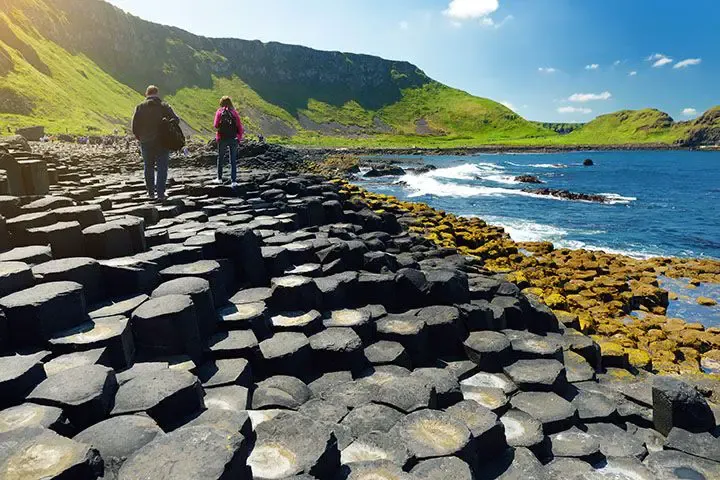
The Giant’s Causeway, in north Antrim, County Antrim, comprises around 40,000 predominantly hexagonal basalt columns descending into the sea - Northern Ireland’s only UNESCO World Heritage Site, and one of the region’s most visited attractions in Northern Ireland.
Formation
The columns were created 50-60 million years ago, during the Paleocene epoch, by basaltic lava flows that cooled and cracked into their distinctive shapes as the North Atlantic began to open. The molten rock pooled and cooled from the top down and the bottom up simultaneously; as it contracted, it cracked into pillars in much the same way drying mud cracks into polygons, just on a far larger and more regular scale. Most have six sides, but the shrinkage process wasn’t perfectly uniform - close to a third are five-sided, and a few have as few as three or as many as eight. Individual stones run 30-150cm across and average around 6 metres tall, though the tallest, nicknamed the Chimney Stack, reaches roughly 12 metres. Depending on who you ask, the story is either one of geology - or of the giant Finn McCool, who according to legend built the causeway to reach Scotland.
Is It Free?
Yes, and this is worth stating plainly, since it’s the most common point of confusion. The causeway stones themselves are free, open-access land, part of a public right of way open from dawn to dusk every day of the year - you can walk down and see them without paying anything. What you pay for is the Visitor Centre and its facilities: parking, the exhibition, guided tours, and audio guides. A Visitor Experience ticket currently runs around £9 for an adult, £4.50 for a child, and £22 for a family (two adults plus up to three children), with under-5s and National Trust members free; booking online in advance is cheaper than paying on the day. If you’re happy to park elsewhere and walk in, or arrive on foot or by bus, seeing the causeway itself costs nothing.
The Visitor Centre
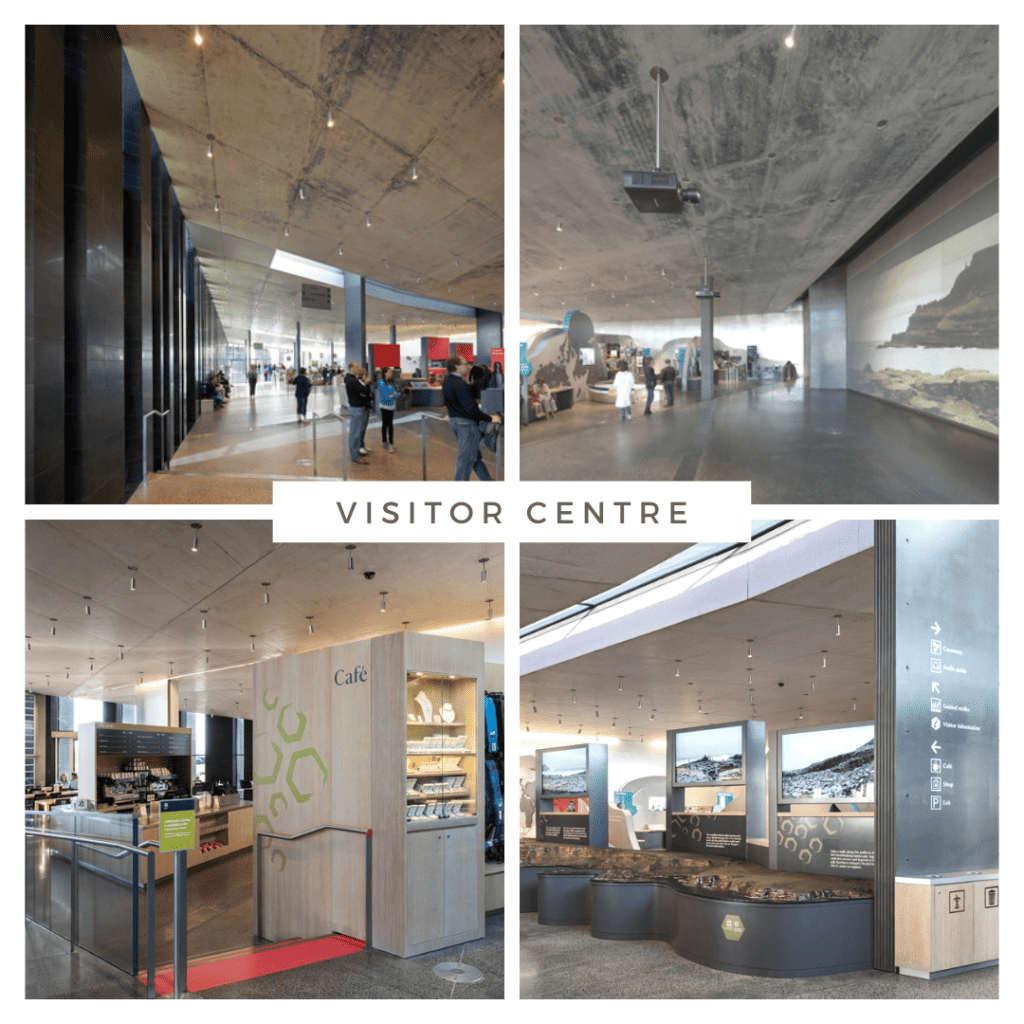
The current, architecturally distinctive Giant’s Causeway Visitor Centre opened in 2012, replacing the original 1986 building put up around when UNESCO first listed the site. Run by the National Trust, it’s free to enter with National Trust membership; otherwise, a Visitor Experience ticket covers the centre, guided tours, and audio guides. Pre-booking online is recommended, with parking available at the main car park and at Innisfree Farm (with shuttle service), bookable via the JustPark app.
Getting There
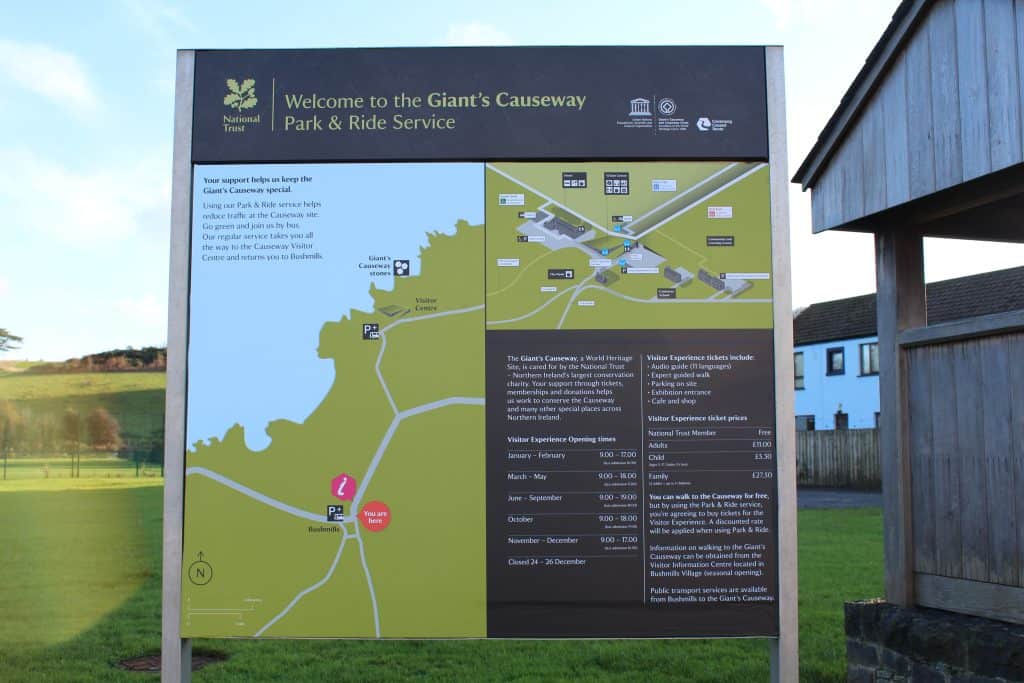
About an hour’s drive northwest of Belfast, three hours north of Dublin, via the Causeway Coastal Route and Causeway Road. Bushmills, Portrush, and Coleraine, all in Northern Ireland, are the nearest towns. From the visitor centre, it’s roughly half a mile on foot down to the stones themselves, on a well-marked, gently sloping path.
History
Though formed tens of millions of years ago, the Giant’s Causeway only came to wider public attention around 1690, following an account by William King, then Bishop of Down and Connor.
Myths and Legends
Legend holds that the Irish giant Fionn mac Cumhaill (Finn McCool) built the causeway to cross the North Channel and confront the Scottish giant Benandonner - a story told in full at the Visitor Centre. In the fullest version, Finn builds the causeway, strides across, and gets his first real look at Benandonner - who turns out to be considerably bigger than him. Finn retreats home, and his wife Oonagh, quick-thinking, disguises him as a baby in a giant cradle. When Benandonner arrives and sees the size of the “baby,” he reasons that the father must be enormous indeed, panics, and flees back to Scotland, tearing up the causeway behind him so Finn can’t follow. What’s left, so the story goes, is the stub here in Antrim and its matching stub across the water at Fingal’s Cave.
Named Rock Formations
Individual formations along the coastal walk have their own names, mostly earned through resemblance rather than any deeper meaning: the Giant’s Boot, a single large stone said to have fallen from Finn’s foot as he ran; the Wishing Chair, a naturally hollowed seat in the rock, worn smooth by generations of visitors sitting in it; the Giant’s Organ, a set of tall, closely packed pillars resembling pipes; the Camel’s Hump; the Giant’s Harp; and the Chimney Stacks (or Chimney Tops), a cluster of the tallest formations on the site, isolated from the main causeway and visible from the clifftop paths above. Local tradition also points out the Giant’s Granny, a weathered rock face said to resemble an old woman looking out to sea.
Walking Trails
Red Trail - around 2 miles, from the Visitor Centre along the clifftop, descending a steep staircase to the coastal path below - genuinely worth the effort for the views.
Blue Trail - the main path from the visitor centre past the cliffs to the causeway itself.
Yellow Trail - follows the World Heritage Site’s perimeter from Runkerry Head to Hamilton’s Seat.
Green Trail - wheelchair and buggy-friendly, fenced off from the clifftops, suited to families with young children.
A shorter guided “wee walk” is also available for those wanting a brief, story-led introduction to the site’s geology and folklore.
The Giant’s Causeway in Popular Culture
The site’s most famous cultural appearance is Led Zeppelin’s 1973 album cover for Houses of the Holy. Design studio Hipgnosis, working under Aubrey Powell, shot the cover here over ten days, photographing siblings Stefan and Samantha Gates scaling the stones at dawn and dusk to capture the light at both ends of the day; the final image is a composite of several shots blended together. The concept was inspired by Arthur C. Clarke’s novel Childhood’s End, and the cover was nominated for a Grammy Award for Best Album Package in 1974. The Causeway’s otherworldly geology has made it a recurring backdrop for film, television, and photography ever since, though the Led Zeppelin cover remains its best-known cultural claim.
Popularity and Visitor Numbers
The Giant’s Causeway is consistently among Northern Ireland’s most visited paid attractions. Visitor numbers peaked at close to a million a year through 2017-2019, collapsed by roughly 95% during the 2020 pandemic lockdowns to around 140,000, and have been recovering steadily since - 663,000 visits in 2023 and 684,000 in 2024, still short of the pre-pandemic peak but trending back toward it. In practice, this means the site never feels empty even outside peak summer months; if you want the stones to yourself, early morning or late evening - when the Visitor Centre may be closed but the causeway itself, being open access, still isn’t - are genuinely quieter than the midday coach-tour rush.
Similar Sites Worldwide
Hexagonal basalt columns aren’t unique to the Causeway Coast - the nearest comparable formation is Fingal’s Cave, on the Scottish island of Staffa, with further examples in Iceland, Mexico, and elsewhere.
Flora and Fauna
The area is a haven for seabirds - fulmar, petrel, cormorant, shag, redshank, guillemot, and razorbill - alongside rare plants including sea spleenwort, hare’s-foot trefoil, vernal squill, sea fescue, and frog orchid.
Accessibility
The Visitor Centre has ramps, lifts, and accessible facilities throughout, with audio guides and tailored tours available. A paved path runs from the car park to the stones, and the Causeway Rambler and Antrim Coaster bus services offer accessible transport for those who prefer not to walk. The Bushmills Visitor Information Centre’s Green Ticket bundles parking, bus fare, and Visitor Experience admission.
Frequently Asked Questions
Is the Giant’s Causeway natural? Yes - the hexagonal basalt columns are a genuine geological formation, created by cooling volcanic lava around 50-60 million years ago. The Finn McCool story is folklore layered on top of a real, scientifically explained landscape, not an alternative to it.
How long is the Giant’s Causeway? The exposed columns themselves stretch for a few hundred metres along the shoreline; most of what’s called “the Giant’s Causeway” as an experience is really the walk to reach them, roughly half a mile each way from the Visitor Centre on the main path.
What are the opening hours? The stones are accessible dawn to dusk year-round, free of charge. The Visitor Centre itself typically opens from 9am, with closing times shifting seasonally (as late as 6pm in June and July, as early as 4pm in winter) - check current times before travelling, since they do change with the season.
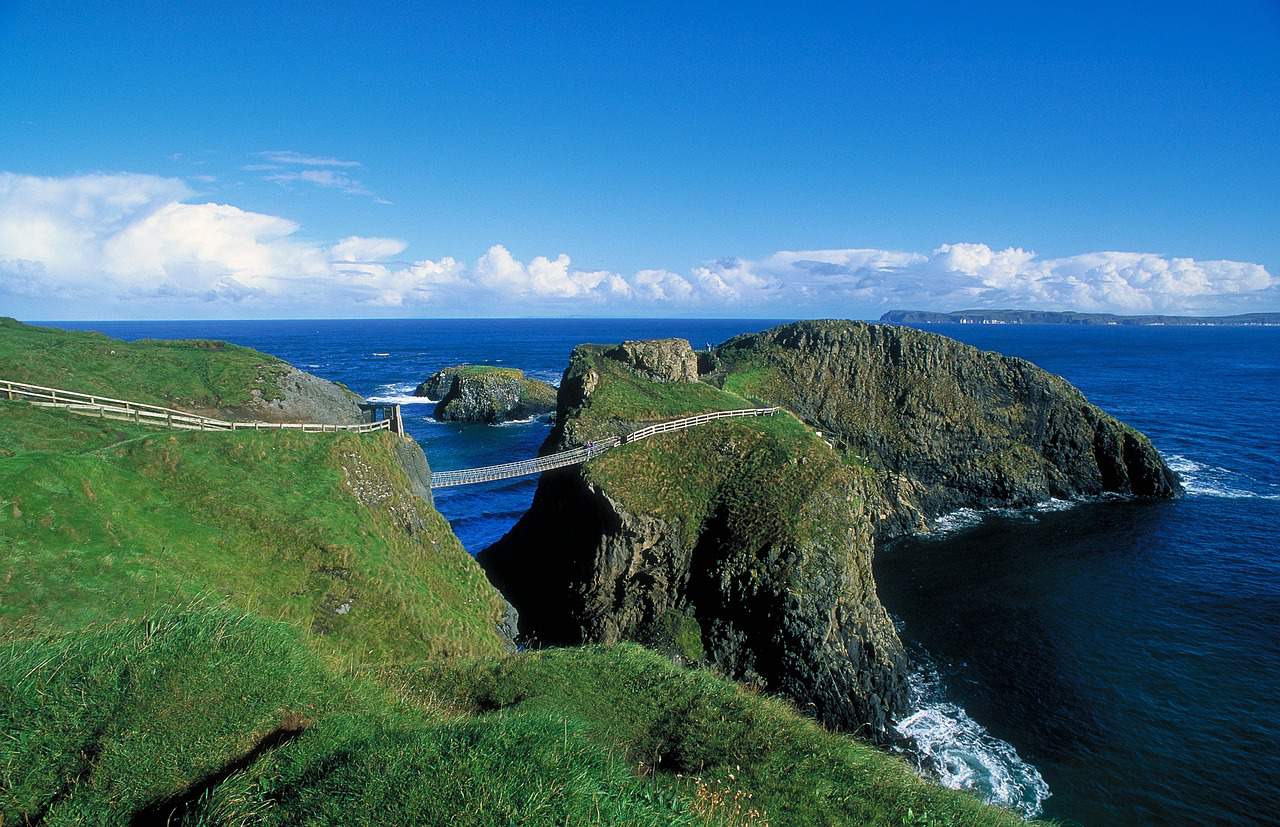
Is the Giant’s Causeway worth visiting? For most visitors, yes - it’s Northern Ireland’s only UNESCO World Heritage Site and a genuinely unusual landscape, not just a photo opportunity. Whether it’s worth a long detour depends on how much you value geology and coastal walking versus other Causeway Coast stops like the Carrick-a-Rede Rope Bridge or Dunluce Castle, which are quicker visits and a genuinely popular pairing with the Giants Causeway for visitors doing the coast in one day.