
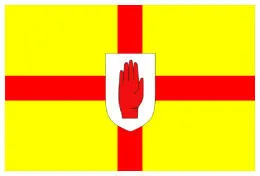
The Ulster Flag is one of the four provincial flags of Ireland, representing the historic province of Ulster - distinct from the Ulster Banner (the former official flag of the Northern Ireland government), though the two are often confused.
Design and Origins
The flag features a red cross on a yellow background, with a red hand on a shield at the centre - the Northern Ireland flag (Ulster Banner) uses a similar cross-and-hand design on a white field instead. The design’s true origin is genuinely debated. The most commonly told version links it to the legend of the Red Hand of O’Neill: in a race to claim land, one contender cut off his own hand and threw it ashore first, winning the claim - the red hand commemorating that sacrifice. Other theories attribute the design to Walter de Burgh, 1st Earl of Ulster, merging his family’s heraldic arms (a red cross on gold) with the Red Hand of the Irish over-kingdom of Ulaid when he became Earl in 1264; or to King James VI and I combining the cross of St George with the red hand to represent the new Plantation-era province. None of these theories is definitively proven.
Ulster comprises nine counties: Antrim, Armagh, Cavan, Derry, Donegal, Down, Fermanagh, Monaghan, and Tyrone - a historic province distinct from the six-county political entity of Northern Ireland (Antrim, Armagh, Derry, Down, Fermanagh, and Tyrone).
Historical and Political Use
The flag has been used across a range of contexts - from the Plantation era (asserting new settlers’ presence) through the 1912 Ulster Covenant (opposing Home Rule) to today’s unionist and loyalist community and sporting events. Irish nationalist and republican communities have generally used different symbols instead, such as the Irish tricolour and the Starry Plough.
An Ongoing, Contested Symbol
The Ulster Flag remains genuinely contested in Northern Ireland today - some see it as a proud marker of regional heritage, others as a divisive symbol tied to one community rather than the whole of Northern Ireland’s population. Debate over its use in public spaces continues, reflecting the region’s broader, still-unresolved questions of identity and constitutional status. This project takes no position on that debate - the flag is presented here as a real, significant part of the region’s visual and political landscape, not as one that should be read one way or another.