
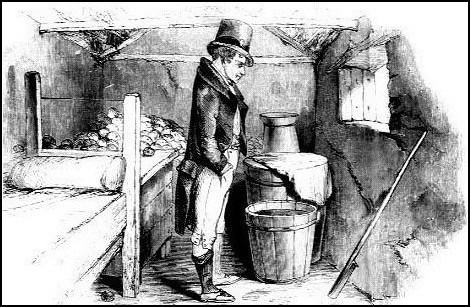
The Irish Potato Famine is one of the great tragedies of the 19th century. It struck from 1845, with its worst years running through 1848, though its effects were felt for much longer. During that time Ireland lost more than a quarter of its population - of about 8 million inhabitants, roughly one million died and another million or more emigrated. Here’s the story, briefly told, and a tribute to those who died.
Ireland Before the Famine
Before the Famine, Ireland had a population of about 8 million - the population of the whole island, since there was no Northern Ireland or Republic of Ireland at the time; partition didn’t happen until 1921. Most arable land belonged to English or Anglo-Irish landlords, many of whom lived in England, who in turn let their land out to Irish tenants. Most tenants held small plots for which they paid rent; landless labourers sought work among the tenants in exchange for a small garden plot to grow potatoes and a place to live, often little more than a one-room mud cabin shared with whatever livestock the family had.
Potatoes for Every Meal
The potato was the staple food of the poor. Introduced to Europe from the Americas in the 16th century, it became the principal food crop for Ireland’s rural poor, while other, more valuable crops were often grown for export rather than local consumption. Despite being among the poorest countries in Europe before the Famine, Ireland’s poor generally enjoyed reasonably good health, since the potato is a nutritious food providing many essential nutrients.
Ireland had experienced regional potato crop failures before 1845, but a bad harvest in one county was usually offset by a good one elsewhere, so famine had generally been avoided. That changed in 1845.
Cause of the Irish Potato Famine
The trouble began in September 1845. The cause was an airborne pathogen called Phytophthora infestans, commonly known as “blight” (technically an oomycete, or water mould, rather than a true fungus, though it’s often described as one). It seems to have originated in the Americas and was brought to Ireland on ships plying the trade routes, then spread by wind.
Infected leaves would turn black and rot, giving off a foul smell, with the rotting tissue nourishing the fungus-like pathogen further and allowing it to spread rapidly across large areas. It affected the tubers as well as the leaves - potatoes that looked fine when dug would rot within days. Most of the 1845 harvest was destroyed, though the Irish, having weathered smaller regional famines before, hoped to weather this one too.
British prime minister Robert Peel, on learning of the crisis, purchased shipments of corn (maize) and had it redirected to Ireland. These shipments helped, but didn’t solve the problem.
The Difficult 1846
Going into the summer of 1846, hopes were high for a good harvest, and the plants initially looked healthy - but the blight returned and spread across the island again, destroying the crop entirely. The second half of 1846 and the first part of 1847 were probably the worst months of the Famine. When the government changed in London that year, the cheap corn shipments stopped; the new administration instead tried public works schemes and soup kitchens, but these too proved inadequate to the scale of the crisis.
1847 Onwards
The 1847 harvest was blight-free, but because so few healthy potatoes had survived to be planted, the yield was only around a quarter of normal. Then in 1848 the blight returned with a vengeance, destroying nearly the entire crop again. It would be several years before production returned to anything resembling normal levels.
The Aftermath
The years of the Great Famine and its aftermath cost Ireland dearly, with effects still felt today. Roughly a million people died, more from disease associated with malnourishment than starvation itself, and around a million more emigrated - most to America, but also to Britain, Canada, and Australia. Immigrants weren’t always welcomed, facing fears of unemployment, crime, and disease among the populations that received them, though they eventually settled and built prosperous communities, sending money home that helped sustain the Irish economy.
The Famine also caused deep social unrest. Many of the poorest tenants were evicted for failing to pay rent, and widespread anger at the government’s response fed into the Young Irelander Rebellion of 1848, which was quickly put down but left lasting disaffection. As Irish emigrant communities, especially in America, grew more established, many began to envision an Ireland free of British control - while it would be too strong to say the Famine alone caused Irish independence, it undoubtedly deepened the alienation between Ireland and Britain.
Today, memorials to the victims of the Great Famine can be found throughout Ireland, mostly in the Republic but also in Northern Ireland - one of the saddest chapters in the island’s history, and in the history of 19th century Europe.