History of Titanic
The Titanic was conceived at a dinner party in a London mansion one fateful evening in 1907. There two men met: Bruce Ismay, Chairman of White Star Line, and Lord Pirrie (William James Pirrie), Chairman of Harland and Wolff. The topic of discussion was luxury ocean travel, and the two agreed to build a new class of liner that would be the ultimate in luxury and elegance.
The term “RMS” stands for “Royal Mail Ship,” highlighting the historical importance of vessels carrying mail. Work on the new class of ships started on the Olympic, Titanic’s sister ship, in December 1908; she was launched in October 1910 and completed in 1911.
The Construction of the Titanic
Work on the Titanic itself began in March 1909. A third ship, the Britannic - larger than the previous two but belonging to the same Olympic class - was launched in February 1914; her completion as a passenger liner was overtaken by the outbreak of the First World War, and she entered service as a hospital ship in December 1915.
Harland and Wolff was chosen not only because it had the largest shipyard in the world, a fitting place to build what would then be the world’s largest liner, but also as a sign of the close co-operation between the two companies. These three Olympic-class liners were built to compete with the equally luxurious and fast Mauretania and Lusitania of the rival Cunard Line.
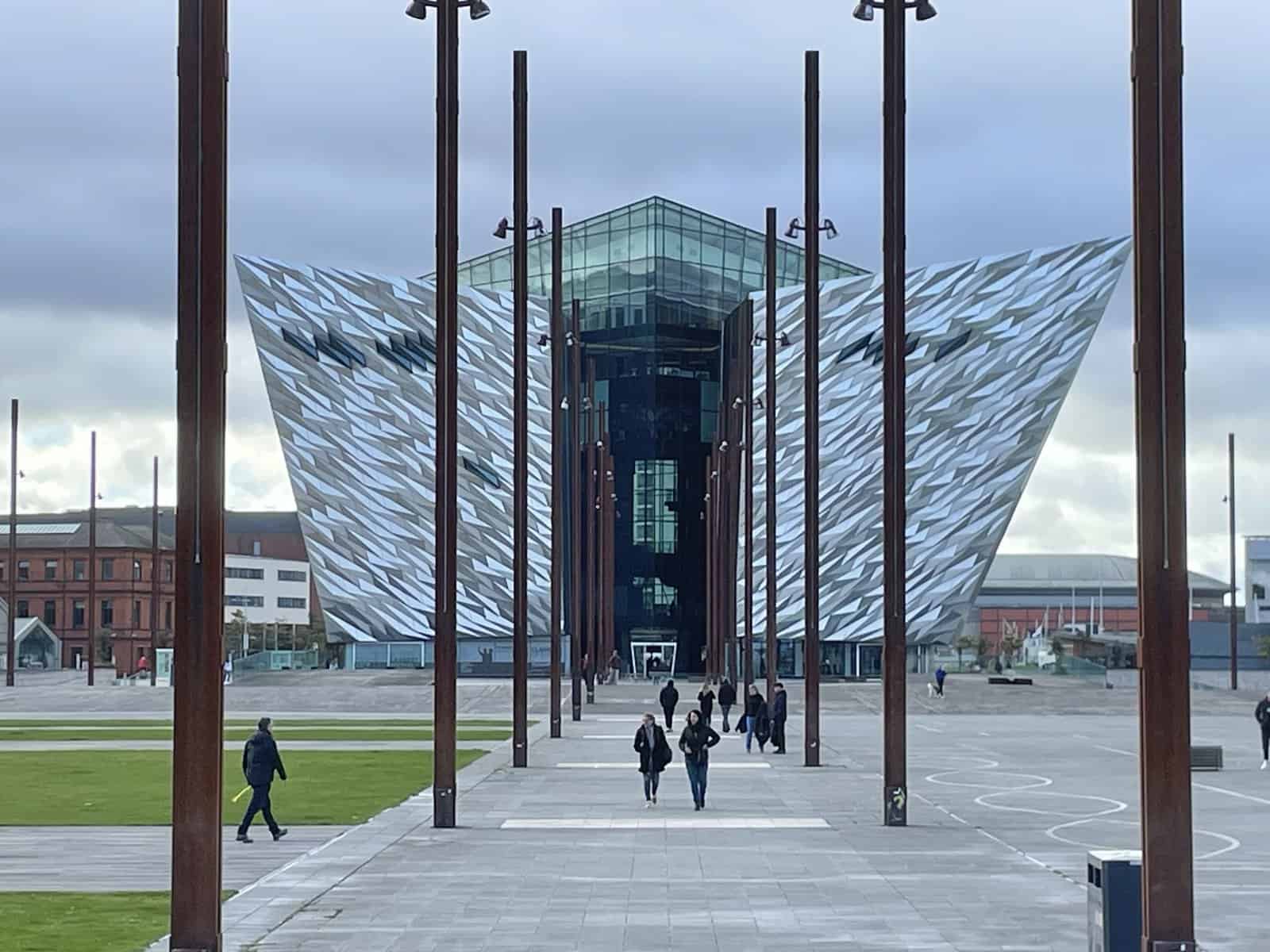
The site where the Titanic was built can be seen in Belfast Harbour and forms part of the Titanic Quarter today. Three thousand Northern Irish workers took part in the Titanic’s construction, out of a total workforce of around 15,000 at Harland and Wolff. The Titanic’s hull was launched on May 31, 1911, to cheering crowds. A local newspaper reported the moment:
“The ship glided down to the river with a grace and dignity which for the moment gave one the impression that she was conscious of her own strength and beauty, and there was a roar of cheers as the timbers by which she had been supported yielded to the pressure put upon them. She took to the water as if she was eager for the baptism.”
She was outfitted by March 1912, underwent sea trials in early April 1912, and on April 2, 1912 she set sail from Belfast for Southampton.
The Construction of the Titanic – Lifeboats
At the time the Titanic was built, Board of Trade regulations required that ships over 10,000 tons carry 16 lifeboats, plus enough rafts and floats for an additional 50% of that capacity. The problem was that the regulations were outdated: when they were set in 1894 the largest ships displaced around 13,000 tons, whereas the Titanic displaced over 46,000 tons.
The Titanic carried 16 lifeboats plus four folding “Collapsibles,” meeting regulations but not enough for all passengers and crew when fully loaded. Alexander Carlisle, who had been chief draughtsman at the initial stages of construction, had suggested a design capable of carrying up to 48 lifeboats; the suggestion was never carried out.
Titanic 1912 Sinking: The Tragedy
On April 2, 1912, the Titanic left Belfast for Southampton. Once there, she was loaded with supplies - tons of meat, fish, cereals, fruit and vegetables, tens of thousands of eggs - and passengers came aboard. With everything loaded, the Titanic sailed at noon on Wednesday, April 10, 1912. As she moved off, the displaced water caused a nearby liner, the New York, to snap her moorings and swing towards the Titanic, coming within feet of a collision before a tugboat pulled her clear.
The Titanic then headed to Cherbourg, France, and from there to Queenstown (now Cobh), County Cork, where she took on her final passengers. By the time she set sail from Queenstown, she had well over 2,200 persons on board, crew and passengers combined.
For three days the journey progressed without incident, though reports came in from other ships about icebergs in the area.
Titanic Facts – The Sinking
On Sunday night, April 14, 1912, the Titanic was sailing through calm, clear, moonless Atlantic waters. Throughout the day she had received six iceberg warnings; as a precaution, Captain Edward Smith ordered a slightly more southerly route. Around 11:00 pm a seventh message came through from the wireless operator of the Californian, warning that she was surrounded by ice - but the message never reached the Titanic’s captain.
At 11:40 pm, lookouts Frederick Fleet and Reginald Lee spotted an iceberg dead ahead and raised the alarm. Officer William Murdoch ordered a hard turn and the engines put full astern, but the manoeuvre wasn’t enough: the iceberg scraped along the starboard side, opening a gash that flooded the front five or six of the Titanic’s sixteen watertight compartments - more than the ship could survive.
The Titanic’s Last Moments
Water poured in quickly. Thomas Andrews, the engineer who had overseen the Titanic’s construction and was travelling on her maiden voyage, assessed the damage and told the captain the ship would sink within two hours. The order was given around 12:25 am to call for help and begin evacuation - women and children first - though the lifeboats could only carry about half of those on board.
The distress call was picked up by the land station at Cape Race, Newfoundland, and by several ships, the closest of which was the Carpathia, roughly 58 miles away and racing to help. By 2:00 am, all 16 main lifeboats had been launched and the crew was working on the collapsibles as water reached the bridge. Just before 2:20 am the power failed, the stern rose high into the air, the ship broke in two, and the Titanic was gone.
History of Titanic – The Californian and the “Mystery Ship”
The steamer Californian, also travelling from England to the US but without passengers, had stopped for the night nearby after sighting ice. Her wireless operator had gone off duty and so never received the Titanic’s distress signals, though crew members on deck reported seeing a brightly lit ship and, later, distress rockets. Captain Stanley Lord was informed but didn’t act on it. Whether the Californian was in fact the “mystery ship” visible from the Titanic that night has never been conclusively settled, though it remains the most widely accepted explanation.
Passengers on the Titanic
The Titanic carried more than 2,200 people, with some estimates as high as 2,240. A commonly cited breakdown gives roughly 325 first-class passengers, 285 second-class, 706 third-class, and 885 crew.
Famous passengers included John Jacob Astor IV, the wealthiest man on board, who died when the ship sank while his wife survived; Benjamin Guggenheim, who reportedly dressed in evening wear to face death “like a gentleman”; and Thomas Andrews, the Comber, County Down-born engineer who oversaw the Titanic’s construction and died helping passengers to the boat deck.
Titanic Survivors
The saddest of the Titanic’s facts: of those on board, around 1,500 lives were lost and roughly 706 were rescued by the Carpathia. Survival rates varied sharply by class - first- and second-class passengers survived at far higher rates than third-class passengers and crew, and women survived at far higher rates than men, reflecting the “women and children first” evacuation order and the more limited access many third-class passengers had to the boat deck.
Most of those who died did so from exposure in the near-freezing water rather than drowning outright.
Memorials
Around 333 bodies were recovered after the sinking; about half were buried in Halifax, Nova Scotia, while identified victims were returned to their families. Memorials stand on both sides of the Atlantic, including one at Belfast City Hall.
The Titanic Band
The Titanic’s musicians are remembered for playing on as the ship went down, helping to keep passengers and crew calm. The bandleader, Wallace Hartley, was born in Colne, Lancashire, and had worked for years as a musician on ocean liners. Survivors reported the band’s final song as “Nearer, My God, to Thee,” though wireless operator Harold Bride recalled a piece called “Autumn” - since none of the eight band members survived, the truth will never be known for certain. Hartley’s body was recovered two weeks later and returned to England for a funeral attended by huge crowds; he’s remembered with a memorial in Colne and a plaque naming all eight bandsmen in Liverpool’s Philharmonic Hall.
The Discovery of the Titanic Wreck
Dr Robert Ballard, an oceanographer and former US Navy commander, had long been interested in finding the wreck. A first attempt in 1977 aboard the Alcoa Seaprobe ended early due to equipment problems. In the summer of 1985, Ballard and Frenchman Jean-Louis Michel led a joint French-American expedition, first searching by sonar aboard the French ship Le Suroît, then switching to a remotely-operated submersible aboard the American research vessel Knorr.
On September 1, 1985, the team found wreckage, including one of the Titanic’s boilers - the wreck was located at a depth of roughly 3.8km, about 600km (370 miles) southeast of Newfoundland. Ballard returned the following year aboard the submersible Alvin to view the wreck up close.
The wreck lies in two main sections. The bow, which sank first, is in comparatively good condition; the stern, which broke away as the ship sank and continued to fall separately, suffered far more damage - possibly compounded by an implosion as it sank deeper. Ballard and his team deliberately left artefacts undisturbed, viewing recovery as akin to grave-robbing, though subsequent expeditions and legal disputes over ownership of recovered artefacts have continued in the decades since.
Legacy
The Titanic disaster led directly to major changes in maritime safety, including the requirement for enough lifeboats for everyone on board, mandatory round-the-clock wireless watch, and the establishment of the International Ice Patrol to monitor iceberg danger in North Atlantic shipping lanes - changes that shaped maritime safety for generations that followed.