Northern Ireland is part of the United Kingdom, not an independent nation, and its flags reflect a genuinely complex, contested history - presented here neutrally, without endorsing any one political position.
A Brief History
Most flags associated with Northern Ireland today emerged in the 20th century, marking specific historical moments. The Ulster Banner held official status as the flag of the Northern Ireland government from 1953. The Northern Ireland Parliament was prorogued in 1972, with direct rule from Westminster following; the Ulster Banner’s official status was then formally ended by the Northern Ireland Constitution Act 1973. It’s now flown unofficially, primarily by unionist and loyalist groups.
The Union Flag
The Union Flag represents the United Kingdom as a whole, combining the crosses of St George (England), St Andrew (Scotland), and St Patrick (Ireland). It has been flown in Ireland since the Act of Union in 1800, and remains a symbol of British identity and sovereignty in Northern Ireland today - though, as with most flags on this list, its display carries real political weight, and it’s not universally embraced across the region’s communities.
The Ulster Banner
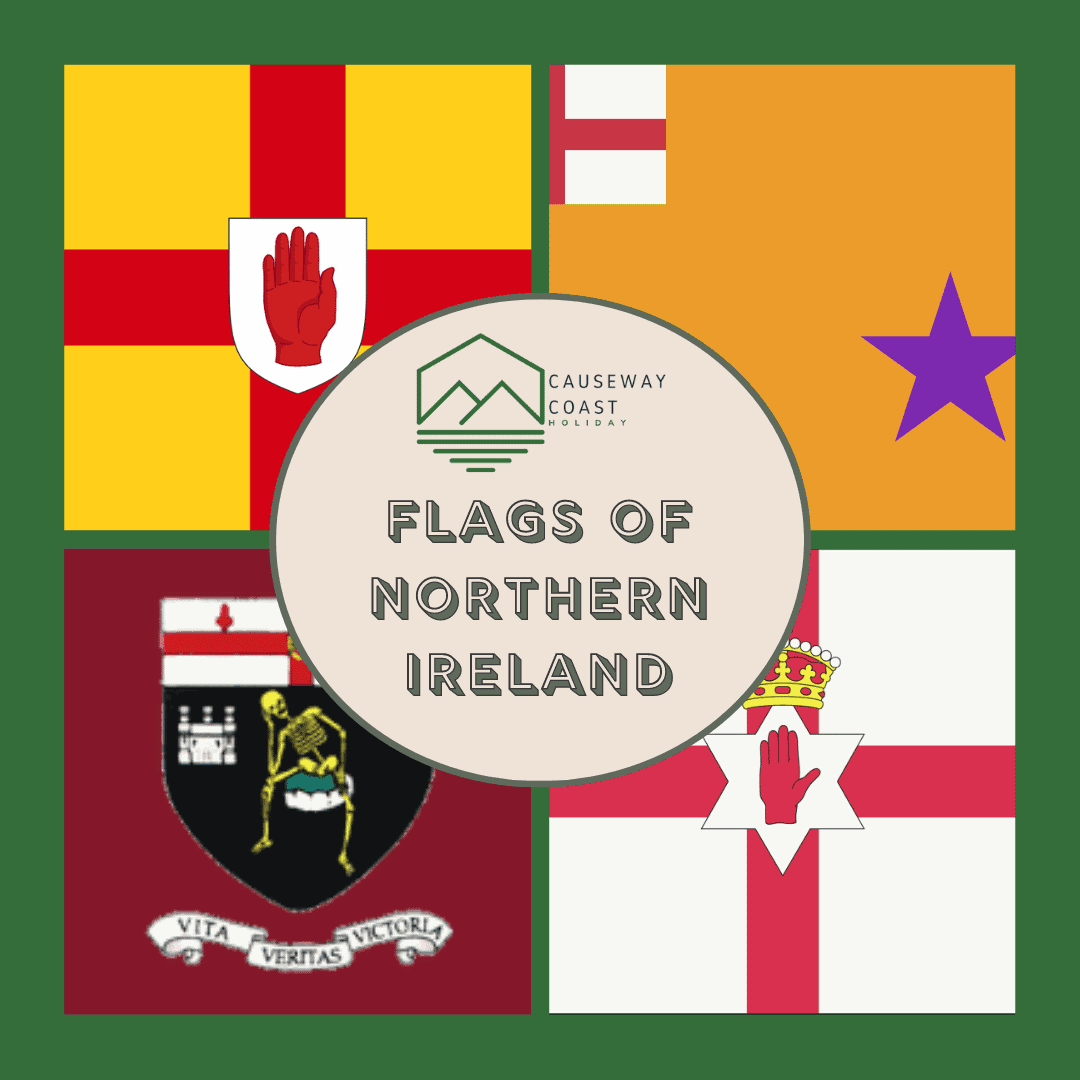
Introduced in 1953, the Ulster Banner incorporates the coat of arms granted to the Government of Northern Ireland by royal warrant: a red cross on white, with a six-pointed star at the centre bearing the Red Hand of Ulster, topped by St Edward’s Crown. Though no longer official, it continues to be flown with pride, particularly at unionist and loyalist events.
The Ulster Flag (Cross of St Patrick Variant)
A red cross on a yellow background with the Red Hand of Ulster on a shield at the centre - one of the traditional provincial flags of Ireland, distinct from the white-background Ulster Banner.
Saint Patrick’s Saltire
A red saltire (diagonal cross) on white, associated with Ireland’s patron saint. It’s more closely tied to Irish nationalist and broader Irish identity than specifically Northern Irish unionist identity, and isn’t commonly flown within Northern Ireland itself, though it remains a recognised symbol of the wider island’s heritage.
The Red Hand of Ulster
A widely recognised regional emblem, closely associated with unionism and loyalism today, and used by groups including the Ulster Defence Association and Ulster Volunteer Force. Its origin legend - the Red Hand of O’Neill, a figure tied to the Uí Néill (O’Neill) dynasty, said to have cut off his own hand to be first to touch the land and win a claim to it - predates the modern political associations by centuries.
The Irish Tricolour
Green, white, and orange, first flown during the Young Irelander Rebellion of 1848 and later adopted as the Republic of Ireland’s national flag. Green represents the nationalist tradition, orange the Protestant/unionist tradition, and white the aspiration for peace between them. In Northern Ireland, it’s closely associated with Irish nationalism and republicanism, and its display is sometimes seen as provocative by unionists and loyalists.
The Starry Plough
A green field (in its original form) with the stars of the Plough constellation, associated with Irish socialism and republicanism. Designed by William H. Megahy (with George William Russell sometimes credited as originating the concept), unveiled on 5 April 1914 for the Irish Citizen Army, founded the previous year. It was flown over Dublin’s Imperial Hotel during the 1916 Easter Rising. A later blue variant, designed in the 1930s, became associated with the Irish Labour movement.
The Sunburst Flag
Featuring a gold sunburst on blue, associated with Irish republicanism and used historically by the Irish Republican Army. Flown by republicans and nationalists supporting a united Ireland.
County Flags
Northern Ireland’s six counties (Antrim, Armagh, Down, Fermanagh, Londonderry, Tyrone) each have historic county flags, genuinely registered with the Flag Institute - real, if largely ceremonial, designs distinct from any single “official” Northern Ireland flag (which doesn’t exist beyond the Union Flag). Specific heraldic details for each weren’t independently re-verified in full this pass; treat individual colour/symbol descriptions as a starting point rather than a confirmed-precise reference.
Flags as Territorial and Political Markers
Flag displays in Northern Ireland carry real, ongoing political significance - used by community and political groups to mark territory and assert identity, sometimes for extended periods well beyond any specific commemorative event. This remains a genuinely live, sensitive aspect of everyday life in parts of Northern Ireland, reflecting the region’s continuing, unresolved constitutional question rather than settled history.